AI Projects

AI that has already shipped — at the edge, in the field and on-premise.

A selection of AI projects from the engineers behind IPNET: private LLMs that keep source code in-house, vision models running on solar-powered roadside devices, and sensing pipelines that count people without a single video frame leaving the building.

10
Selected projects
3
Field & production deployments
2019–2026
Years covered

About these projects. They were designed and delivered by members of IPNET’s engineering team, including work completed in previous roles before joining IPNET. Client and venue names are withheld for confidentiality.

LLM & sovereign AI

Private language models, retrieval and voice — running on hardware you own.

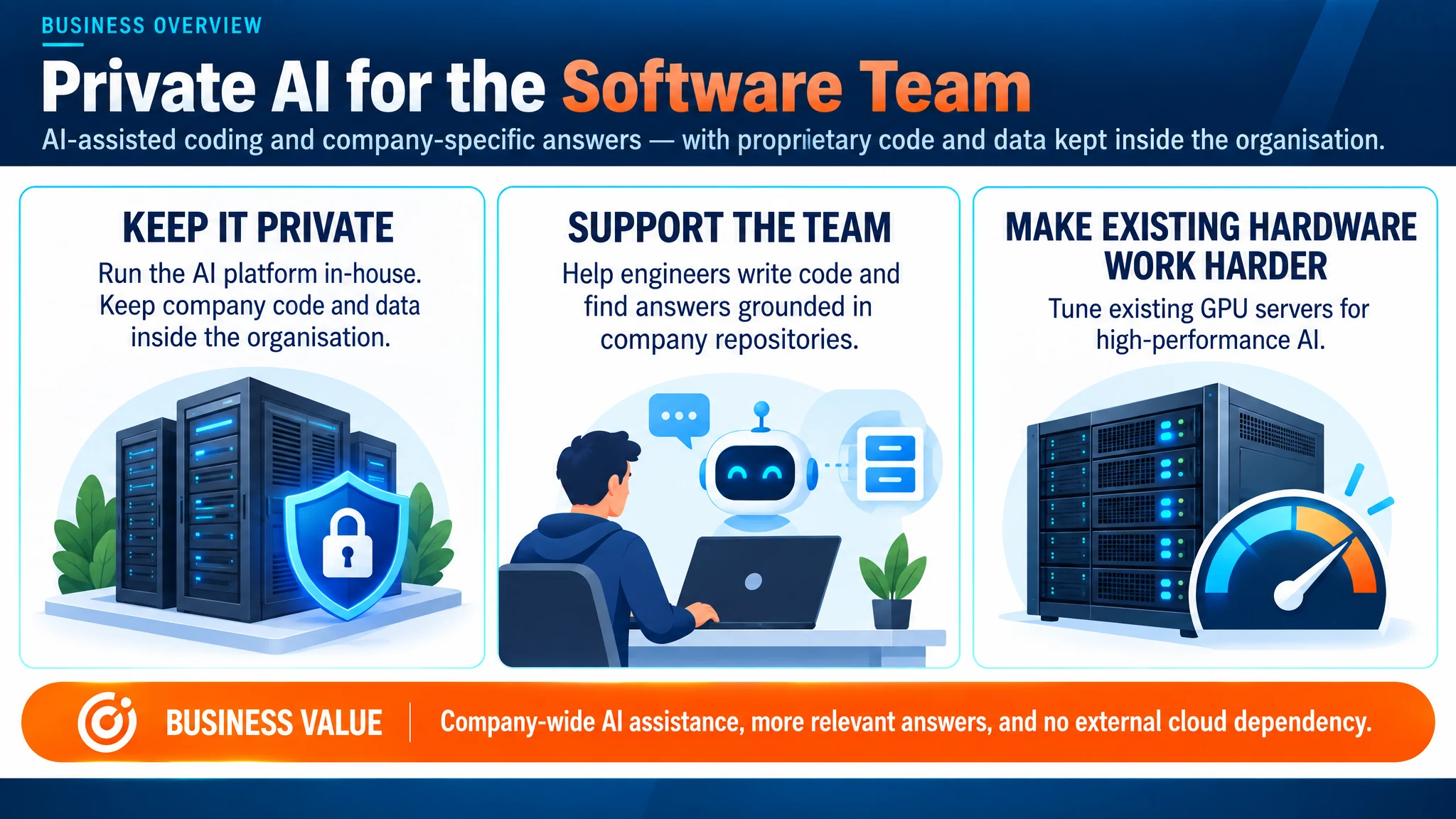
Infographic: private AI for the software team, kept in-house on existing GPU servers
01 Deployed 2026

Sovereign local LLM stack for a software team

Challenge
A software team needed AI coding assistance without sending proprietary source code to a cloud service.
What was built
Tuned llama.cpp for full GPU layer offload — first on an 8 GB GPU, then on a 100 GB-VRAM machine — connected an open-source coding CLI to the local model, and exposed retrieval over the internal repositories as an MCP server. Colleagues were coached through adoption.
Outcome
An AI coding CLI available to everyone in the organisation, with every line of code and data staying in-house.
  • llama.cpp
  • GPU layer offloading
  • Opencode CLI
  • ChromaDB
  • RAG
  • MCP server
Where this applies
  • Generative AI for teams bound by confidentiality or data-residency rules
  • AI pair-programming and knowledge search over internal code and documentation
  • A predictable-cost alternative to per-seat cloud AI subscriptions
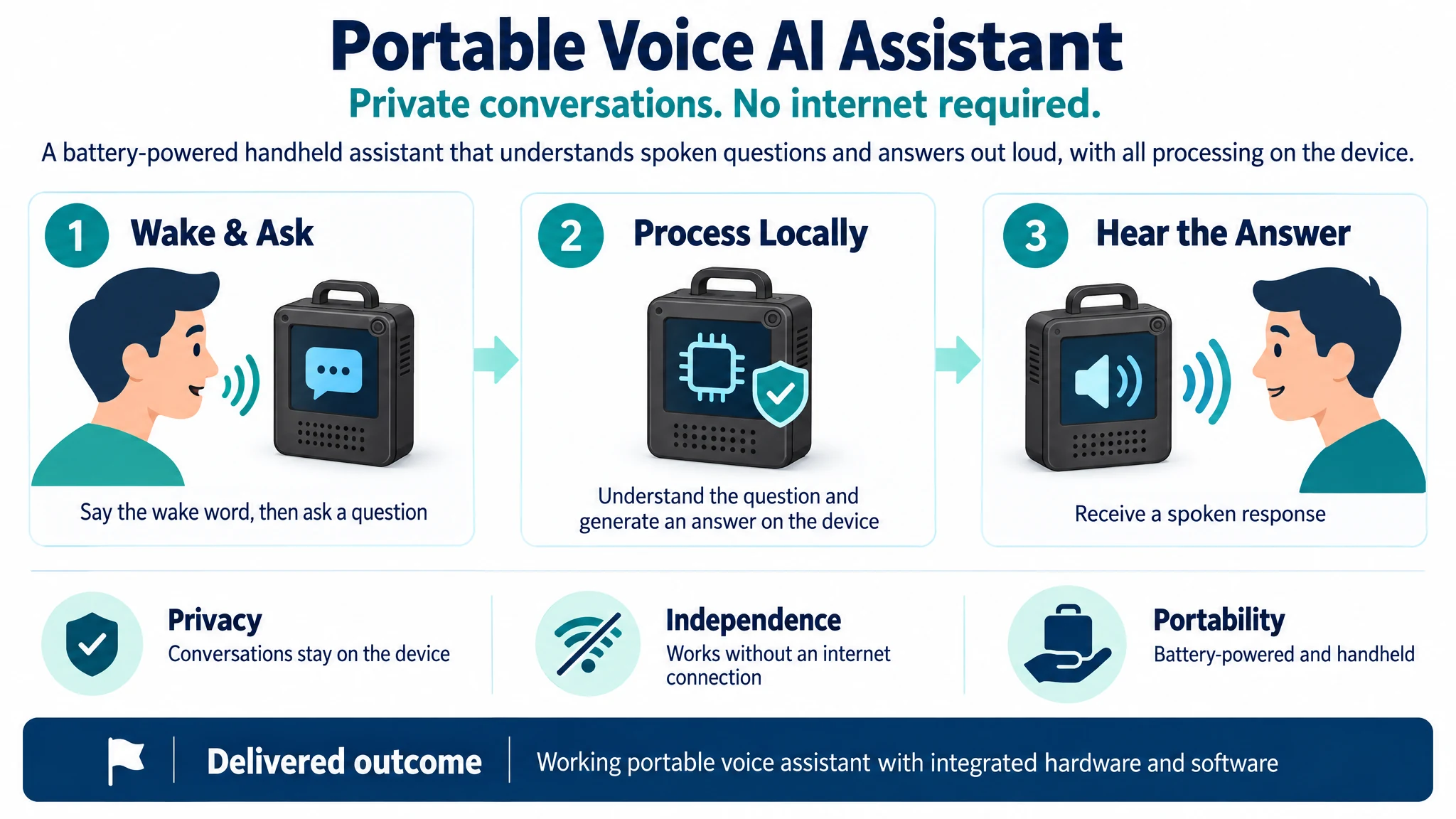
Infographic: portable voice AI assistant that processes everything on the device
02 Client delivery 2025

Portable offline voice assistant

Challenge
A client wanted a handheld voice assistant that keeps working without a network connection.
What was built
Built a battery-powered Raspberry Pi device with screen, microphone and speaker: wake-word detection, on-device speech-to-text, a local LLM for the answer and on-device text-to-speech for the reply.
Outcome
A working portable voice AI product, delivered to the client. Conversations never leave the device.
  • Local LLM
  • On-device STT
  • On-device TTS
  • Wake word
  • Raspberry Pi
Where this applies
  • Private voice interfaces where cloud audio processing is not acceptable
  • Hands-free guidance for field and maintenance staff without coverage
  • Kiosks and accessibility devices with no recurring cloud cost
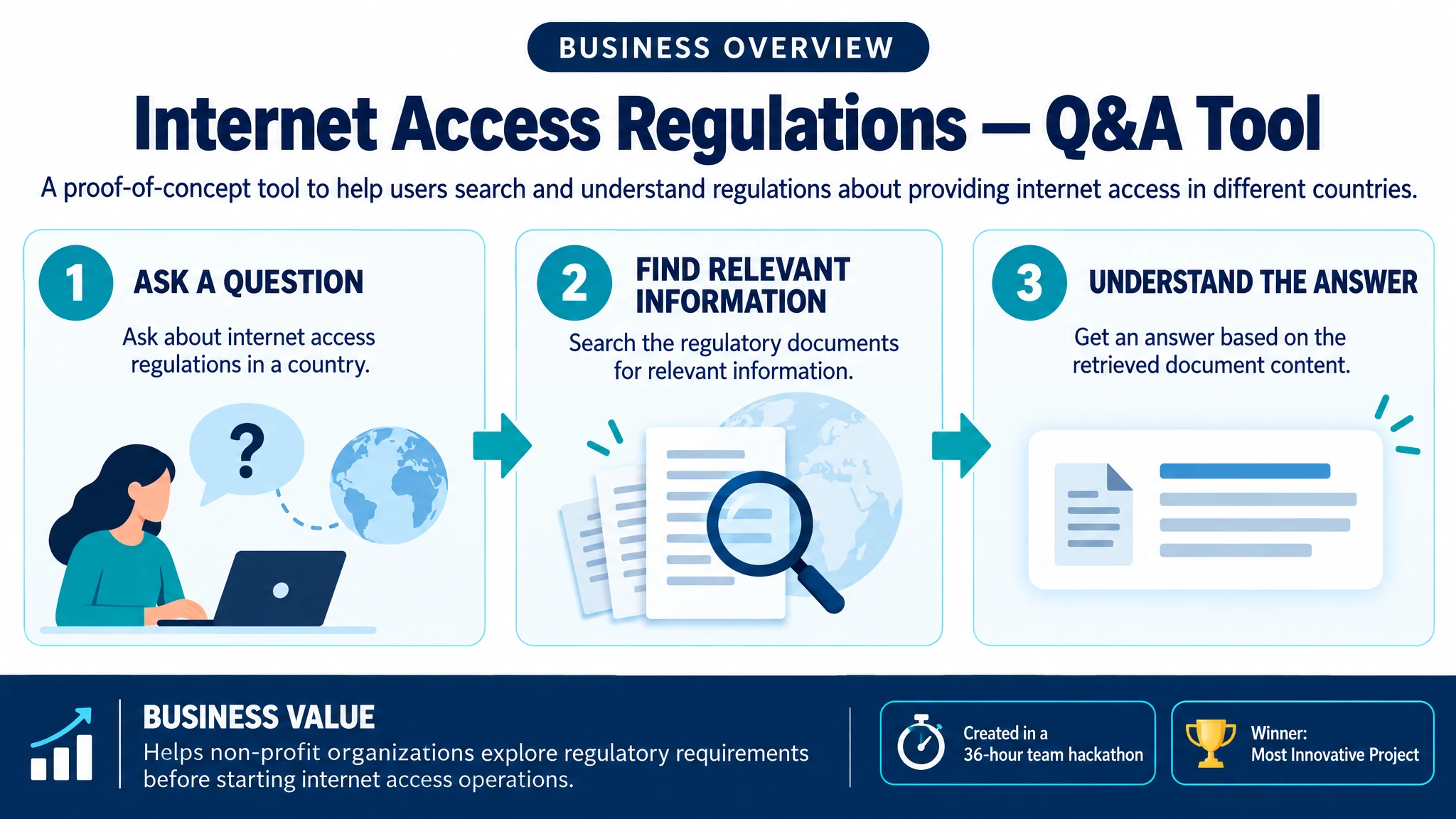
Infographic: question-and-answer tool over internet access regulations
03 Award 2023

RAG over regulatory documents — hackathon winner

Challenge
Charities need to understand country-by-country internet regulations, and the team had 36 hours to build something useful.
What was built
Built a retrieval-augmented question-answering system with LangChain and ChromaDB over a library of regulation PDFs.
Outcome
Won the Most Innovative Project award at an LLM/RAG hackathon.
  • LangChain
  • ChromaDB
  • RAG
  • LLM
Where this applies
  • Document assistants for policies, procedures, manuals and contracts
  • Finding the relevant material before consulting a qualified expert
  • Knowledge portals for teams working across many jurisdictions

Edge AI & computer vision

Models running next to the camera — on solar power, over cellular, managed remotely.

04 Deployed 2021–2022

Solar-powered vehicle-counting edge device

Challenge
Parking for a major international sporting event needed live vehicle counts at entrances, from devices that depend on neither grid power nor wired internet.
What was built
Led the design of a solar-powered NVIDIA Jetson Nano device with IP camera, 4G uplink, custom watchdog and battery monitor, running YOLO through TensorRT. Remote access over IPSec VPN; device status over MQTT into Django, counts over RabbitMQ into a map dashboard; 24/7 auto-recovery and one-shot remote updates.
Outcome
Devices deployed in the field for the event, with hardware and software debugged on site.
  • Jetson Nano
  • TensorRT
  • YOLO
  • MQTT
  • RabbitMQ
  • Django
  • IPSec VPN
  • Solar
Where this applies
  • Parking availability and vehicle flow for venues, campuses and public events
  • Temporary smart-site monitoring with no new cabling
  • A reusable platform for counting vehicles, queues or site activity
05 Deployed 2025

Next-generation multi-camera edge device

Challenge
The first-generation device needed stronger hardware and a simpler supply chain.
What was built
Redesigned the platform around NVIDIA Jetson Orin with a custom Modbus watchdog, battery-voltage sensing and a switch for up to four cameras. Sourced the parts, negotiated quotes, assembled and flashed the units, and set up Ultralytics on GPU with hardware-accelerated GStreamer decoding.
Outcome
Field installation completed, with VPN access in place and data flowing to the backend.
  • Jetson Orin
  • JetPack
  • GStreamer
  • Ultralytics
  • Modbus watchdog
Where this applies
  • Multi-camera analytics for parking, roads, industrial sites and large facilities
  • Remote sites where one rugged device serves several cameras
  • A base for counting, safety checks and queue measurement
06 Delivered 2021

Sky-scanning PTZ control for drone detection

Challenge
Protecting airspace from unauthorised drones needs a camera that keeps sweeping the sky rather than staring at one fixed view.
What was built
Wrote Python control software on the PTZ camera's HTTP API. It sweeps a predictable scan pattern and, when the AI detector reports a drone, switches to tracking to keep the target in frame.
Outcome
Delivered the camera-control layer of a drone-detection system.
  • Python
  • PTZ HTTP API
  • Sky-scan automation
  • AI detection hand-off
  • C-UAS
Where this applies
  • Situational awareness for airports, stadiums, campuses and critical sites
  • Automated PTZ patrols for perimeters and large areas
  • Moving-camera tracking for traffic or industrial monitoring
07 Delivered 2025

Edge AI hardware cost and performance study

Challenge
Edge AI deployments needed lower cost and better use of the compute already in place.
What was built
Compared OpenVINO on Intel mini PCs, Jetson edge computers and GPU servers on cost, resource use and size. Rewrote large parts of the vehicle-counting application along the way, including a web tool for drawing counting zones on a camera snapshot.
Outcome
A cost/performance comparison across three hardware classes, plus a rewritten, easier-to-configure counting application.
  • OpenVINO
  • TensorRT
  • Jetson
  • Benchmarking
Where this applies
  • Choosing the right hardware for a new camera-analytics rollout
  • Self-service camera setup for parking, retail and traffic counting
  • Upgrading existing video systems without replacing every camera
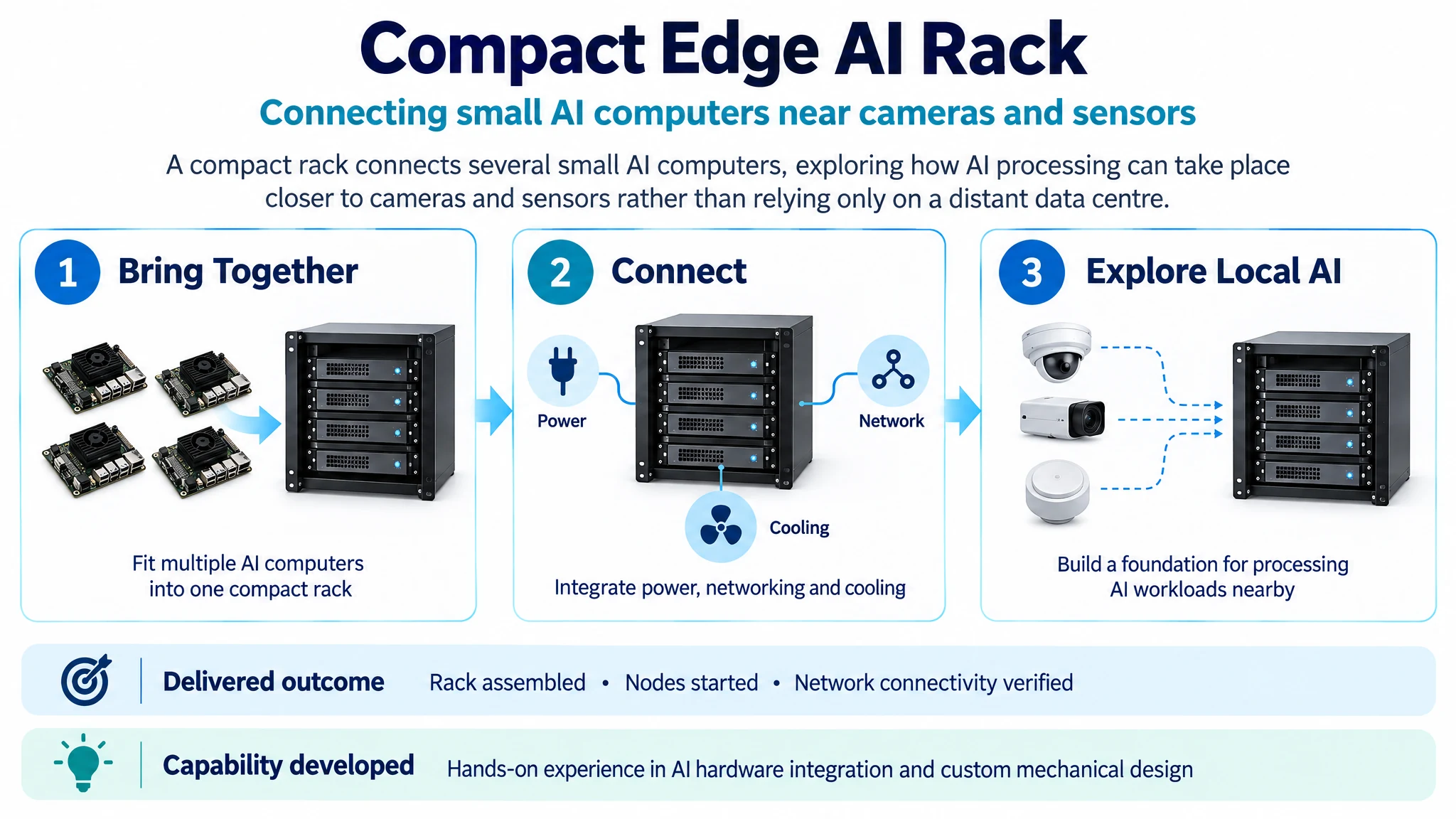
Infographic: compact edge AI rack built from small AI computers
08 Prototype 2019

Rack-mount inference cluster from edge nodes

Challenge
Edge AI workloads needed more compute in a compact, rack-mountable form.
What was built
Combined multiple NVIDIA Jetson NX computers into a single rack-mount server, including the wiring and custom 3D-printed mounts.
Outcome
A working prototype inference cluster built from distributed edge nodes.
  • NVIDIA Jetson NX
  • 3D CAD & printing
  • Rack integration
Where this applies
  • Local AI processing for multi-camera security and safety monitoring
  • A test platform before committing to a large server installation
  • Distributed processing where internet bandwidth is limited

Sensing & occupancy analytics

Counting people and measuring space usage — without relying on standard video.

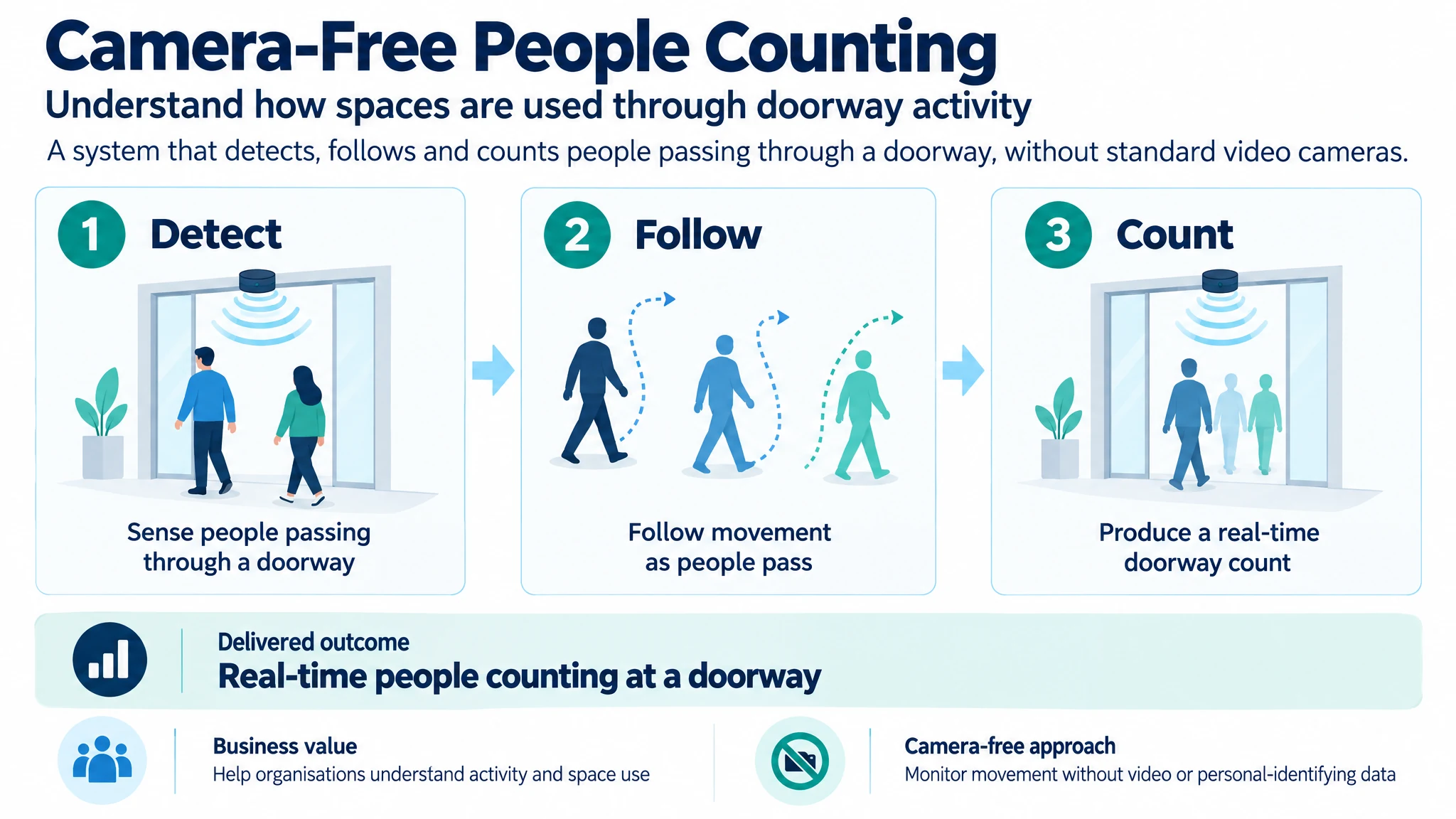
Infographic: camera-free people counting at a doorway
09 Delivered 2020

LIDAR people counting at doorways

Challenge
Counting people through a doorway needs reliable detection and tracking from a LIDAR sensor.
What was built
Implemented the full tracking chain — plot-to-track association, track initiation, maintenance and smoothing — on a 360-point scan stream on a Raspberry Pi. When Python proved too slow, the pipeline was rewritten in C and compiled on the device.
Outcome
The C version ran much faster and tracked better.
  • RPLIDAR-A3
  • C
  • Python
  • Raspberry Pi
  • Multi-target tracking
Where this applies
  • Occupancy counting at office, retail, museum and venue entrances
  • Input for cleaning schedules, staffing and space planning
  • People-flow measurement where a non-camera sensor is preferred
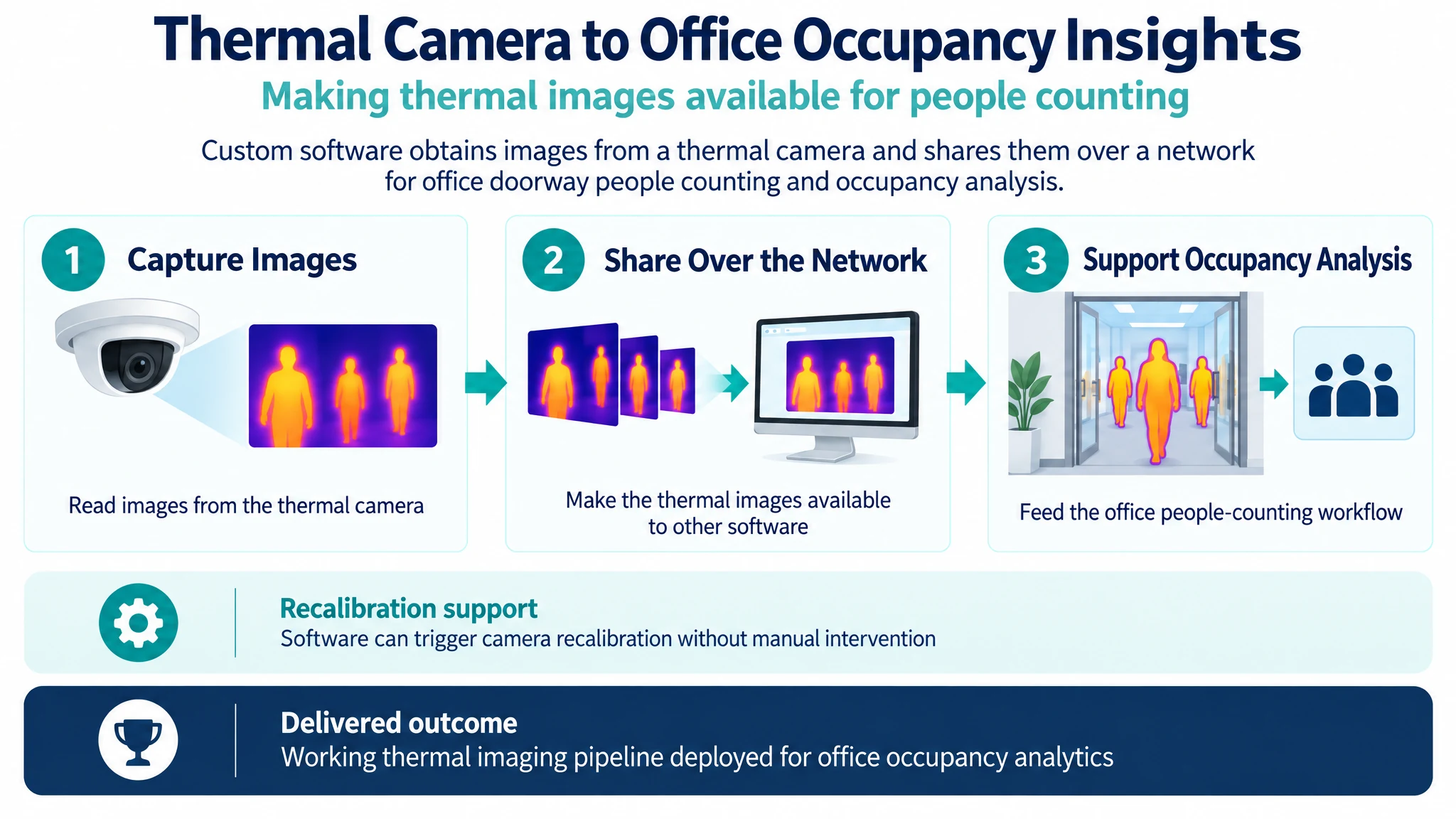
Infographic: thermal camera images made available for office occupancy insights
10 Delivered 2024

Thermal camera driver for occupancy analytics

Challenge
A thermal camera's video had to be usable in software, with control over when the sensor recalibrates.
What was built
Wrote a driver that reads frames from the camera's USB endpoints and streams them as MJPEG over HTTP, and worked with the vendor to implement their proprietary protocol for refresh control.
Outcome
The driver was used to count people through a doorway for office occupancy analysis.
  • Thermal camera
  • USB driver
  • MJPEG / HTTP
  • Vendor protocol
Where this applies
  • Occupancy and people-flow analysis where thermal sensing suits the site
  • Equipment and facility monitoring from temperature imagery
  • Network access to specialised cameras for remote viewing or AI analysis